Showing posts with label Getting Around. Show all posts

Friday, 28 July 2017

About Egypt - Travel Tips (Getting Around) A

Luxor
Taxis are the easiest way to get around Luxor. Any journey within the town centre should cost around EGP 5 or EGP 10 from one end of town to the other, that is, from the south of town to Karnak. This is the price for the car, not for each person. As in Cairo, you can hire a car for the day by agreeing a price with the driver, which is worked out by kilometres.
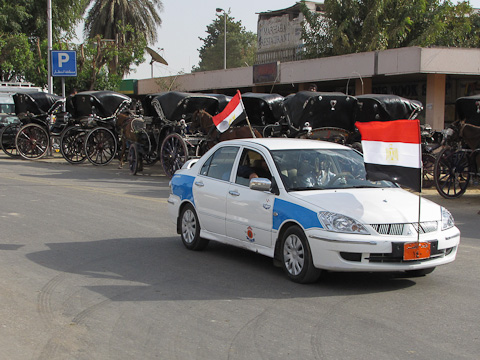
In Luxor, caleches or horse-carriages operate in the same way as taxis for short journeys. This is a more leisurely way to get about and can be cool and pleasant on a warm day or evening. The prices should be the same as taxis, though the caleche drivers seem to argue more. Agree a price for your journey first. The drivers may often try to take you on a roundabout route calling at papyrus shops and bazaars at which they get commission, or they will suggest a visit to the camel market. Be warned, this is only open on a Tuesday! If you don’t want to do this be firm!
There are microbuses or ‘arabayas’ which operate on circuits around the town and this is a very inexpensive way to get around once you know the routes. Any journey in an arabaya should cost 25 piastres (EGP 0.25), but they will often charge tourists EGP 1. You can get on and off anywhere on the route, but they can get very crowded and you may have to share your seat with a basket full of live chickens. It’s good fun if you like adventures.
A passenger ferry operates from the Corniche to the West Bank all day and most of the night. These cross the Nile about every 15 minutes depending on the time of day and cost EGP 1 (for tourists) for each journey. Alternatively the owners of motor boats will constantly tout for your business and usually charge EGP 5 each for a single journey. Look out for Egyptians crossing by motor boats which operate the same way as the ferry and at the same price.

On the West Bank there are taxis to hire. A return trip to the Valley of the Kings should cost around EGP 40-50 per car and the driver will either wait or come back for you at an agreed time. There are arabayas here too in the form of covered Peugeot pick-up trucks which do a circuit of the West Bank but do not go to the King’s Valley. Just wave one down wherever you are and bang on the window to get off. They should cost 25 piastres for any journey, though foreigners may be asked to pay more.
You can also hire bicycles inexpensively in Luxor and on the West Bank. A good way to get around as there are no hills. There is no charge for bicycles on the ferry.
I could go on. There are donkeys, camels, horses, with boys touting for business wherever you go.
Security
Since the mid-1990s there has been a threat to tourists from terrorist activities in Egypt, but except for the Sinai coast, there have been no major incidents since 1997 and security has been stepped up drastically since then. This means that independent travel is not as quite easy as it once was. From 2009 however, the armed police convoy has ended between Aswan and Luxor and down into Middle Egypt and visitors are no longer obliged to travel all together in long lines of vehicles.


About Egypt - Travel Tips (Getting Around)

Getting Around

The easiest and the quickest, though most expensive way to travel around Egypt is by domestic air travel. Egyptair offer a range of daily flights between the larger cities.
From Cairo you can get an airport bus which makes several stops between the airport and the Pyramids Road in Giza. Alternatively there are always lots of taxis waiting at the airport to take visitors to their hotels and the same applies to Luxor, Aswan and other airports.
The whole of the Nile Valley from Alexandria to Aswan is covered by a rail service run by the Egyptian government, but when trying to book a ticket on these trains visitors are often told that they are only allowed to travel on the ‘tourist train’. This is a sleeper train which runs daily from Cairo to Aswan operated by a private company, Wagon Lits and is superbly comfortable even without a sleeper compartment. It is advisable to book tickets at least a day in advance. Otherwise, if you are prepared for an argument at the ticket office, you can travel on any of the frequent government trains which are less expensive and less comfortable.

Air-conditioned coaches operate throughout Egypt and are generally inexpensive with two coaches a day between Cairo and Aswan, but be prepared for a long journey. There are also local buses without air-conditioning between all Egyptian towns. Check the main bus terminals for details of times and costs. It often costs only a little more to travel in the more comfortable coaches.
Cairo
In Cairo and Alexandria there are metro routes covering many parts of the cities. This is an easy, exceptionally clean and inexpensive way to travel around and the underground trains run at very frequent intervals all day. A single journey on the Cairo metro costs 50 piastres (EGP 0.50). The entrance to underground stations can be recognised by a circular sign with an ‘M’ in the centre. In Cairo the metro system is currently being extended. There are usually separate coaches at the front of the trains for women and I would recommend their use by women travelling alone. They are usually much less crowded than the rest of the train and you will not be hassled or treated as an object of curiosity.
There are two types of buses in Cairo. Large overcrowded buses travel routes throughout the city, often with a dozen children hanging on to the sides and you can get to most places on these routes. Smaller more comfortable buses which do not allow standing also operate the major routes. They are an inexpensive way to travel.
A Guide to Public and Private Transport in Cairo, Egypt

Cairo is one of the greatest tourist attractions in Egypt and is full of historical and cultural 

heritage. It's a huge city, and has a large network of roads and other transport options so that people can move around it easily. Here is our guide to the different ways of getting around in Cairo.

Metro is the fastest way of getting around


Plans had been made to build a metro network in Egypt since the 1930’s, but construction only started in the 1980’s. The first line constructed was from Helwan south of Cairo to El Marg north of the city. Metro lines are still expanding in order to make it easier for citizens to move around the city, which is especially important as the streets of Cairo are so crowded. If you’re looking for a fast and an affordable way to reach your destination, then the metro is a good choice as you’ll save yourself from the hassle of the terrible traffic. But do be aware that sometimes the metro also gets very crowded, especially at peak time, so if you’re not willing to deal with the crowds then you should use another way of getting around.

Private transport

If you’re looking for an easy way to reach your destination 
and save time, then private cars are the right thing for you. You have the option of taking a taxi or other private means such as Uber and Careem that help you book a car with few clicks. For a comfy and safe ride from or to the airport London Cab is a great choice too.


Try out the river bus

That’s a bus in the Nile! Although these Nile buses don’t move as fast as you may want them to, it’s still so much better than the traffic jam. So if your destination is along the 
riverside, you can simply ask if the bus goes there. Another perfect thing about the Nile bus is that it can transport you to the historical Coptic area in Old Cairo. Just ask at the river stop which bus is going to Misr Al-Qadima (Old Cairo).

Take the Nile taxi

This is a new method of transportation to save you time – the Nile taxi. You can now use the boats in the river to move about quickly. There are three types of  Nile taxi; those where you have to wait till it fills up with enough passengers, ones where you can pre-book for the time that suits you and the tourist ones.

Take the carriage

Carriages can be found in Downtown, Zamalek, Giza and mainly along Nile Corniche. And although they’re mainly used now for sightseeing now, they are still popular among Egyptians and tourists, especially during holidays and for special occasions.