Showing posts with label T. Show all posts

Thursday, 3 August 2017

Egypt Travel Planner - Travel Tips

Egypt Travel Planner

Be Preparedtrip
Before you embark on your Egypt travel plans it is best if you can read up on the culture of the country, as it is rather unique. Many travelers, who have visited the majority of the world’s countries, find that their “I’ve been everywhere so know all there is to know” attitude takes an enormous blow once they arrive here. Why, well let us see if we can explain.

Egypt is an Islamic country, though about 15-20% of the population is non-Muslim, with Coptic Christians making up the majority. Throughout the world Muslims are regarded as people who do not drink alcohol and are virtual non-smokers … until you come to Egypt. Not only is alcohol tolerated here, not only is it, reasonably, easy to purchase, you will often find yourself in the company of a Muslim who is enjoying a beer and a cigarette; often finishing them in enough time to go and pray in the local Mosque.

Where else in the world will you see a man; sitting on a cart being pulled by a donkey; dressed in a dirty looking galabeya (the male frock that you will often see worn in Egypt); either selling fruit and vegetables or going around the street collecting certain refuse; and then reaching inside his apparel to answer his iPhone! To all intents and purposes this man is no better than a beggar back in your own town, someone who can hardly afford to rub to pennies together, yet he has a piece of technology that you maybe do not own.

Many people have the impression that Muslim women have to have their heads covered, either by a scarf or by wearing the all-enveloping cloak known as a burqa, yet once here something catches their eyes; many, many, women have their heads uncovered. Again, this is something which Egyptian women have been doing foe many years and is perfectly acceptable. Granted, some of these women will be Coptic, but vast amounts of Egyptians have decided not to wear head coverings, and many of those who do are doing it for a non-religious reason: they do not get advances from men when dressed like this!

Hints and Egypt Travel Tips

Here are some hints and egypt travel tips that should help you throughout your stay in Egypt:

If you must take a taxi, then it would be best if you asked at the reception desk of your hotel to get you one. They have certain assigned taxis that they know very well, and deal with on a daily basis. If you are travelling alone, or in a couple, and wish to organise everything yourself, also let the hotel know your plans before you leave. If you should get lost, the hotel will be able to act on your behalf! Take a note of the hotel’s name and telephone number, in case you do get lost, or change your plans.
Egypt is a Muslim country, so please respect their faith. Many things that you take as the norm, such as kissing and/or fondling your partner in public, wearing revealing clothing etc., are frowned upon here, so try to be more conservative in your attitude. Homosexuality is actually illegal in Muslim countries!

Do not rely, solely, on travel books such as Lonely Planet and Rough Guide. Though they do give a lot of good information, they do not explain everything, or how to help if you get into problems. Too many people have come to Egypt armed with one of these books, and have left, very disappointed with their trip, vowing never to return again!


If you wish to organise everything yourself, be prepared for the occasional “rip-off”. Like many other tourist destinations, Egypt has its “wolves”, those who prey on unsuspecting travellers. Often the total cost of an excursion can be a lot more than if you had arranged it through your hotel, or a travel agent, and a lot less enjoyable.

In Egypt they drive on the right, be careful when crossing roads. Take special care in Cairo, where the traffic is a lot busier than in other Egyptian cities: especially outside the Egyptian museum! UK and Japanese travellers should be extra careful, as you will be used to traffic driving on the left.
Buy (and drink) plenty of water. You will find it a lot cheaper to buy in the various shops, than buying at your hotel or cruise boat. You may not drink a lot of water at home, but make sure you do in Egypt. It is very easy to become dehydrated if you do not.
Remember that Egypt is a 3rd world country, and has many poor people who think that all tourists are rich, no matter where they come from in the world! Learn the phrase “La Shukran” (No thank you!) and do not be afraid to say it to anyone who tries to sell you anything, or asks for “baksheesh”. Unbelievably, it does work. Please do not say “Emshi” (as many tour books advise), this can be taken as an insult. If you forget the expression “La Shukran” just politely say “No thank you” and walk away. Do not get abusive to the trader; he is only trying to feed his family.
If you feel that someone is being too pushy, let a member of the Tourist Police know. You will see them everywhere in Egypt and their job is to protect you.

Admission to all sites is payable in LE, so make sure that you carry enough with you. Try and plan each day in advance, work out how much you will need for admissions, and keep this money separate from your spending money.
Take a small, pocket, flashlight with you when visiting the sites. Many tombs, temples etc. use the natural light for illumination (including a local with a large mirror, reflecting the light!) and a small flashlight can be very handy. A small mirror, such as the one in a ladies make-up, can also be used to highlight a relief. Please Note: Do not take one of the really bright halogen torches; you could cause damage to the monuments!

Make up a small “medical-kit” before you go! Include things like safety pins, plasters (different sizes), antiseptic cream, diarrhoea tablets, headache tablets and sun cream
(high factor advised)
When shopping for bargains, keep your own currency and credit cards out of sight, and separate from your LE. It is easier to haggle over a price if you can show that you have only a few Egyptian pounds in your possession! Plus, some traders may try to insist that they meant $ or £, instead of LE, if they see that you are carrying them.
Wear sensible footwear when visiting the various sites. High heels and open toe shoes are not advisable. The floors of most sites are either sand or rough-cut, uneven stone. Inside many tombs, wooden floorboards have been installed, but thin heels could get caught in the gaps between the floorboards.
 

Many monuments have signs that say “No Flash Photography”, please obey these signs (you can be ejected from the site if you ignore the sign!). The very bright flash can cause serious damage to some of the ancient paintwork! Some reliefs have depictions that show male genitalia – this is not pornography, so there is no reason to be offended! If you are part of a group (of any size) the leader/guide will explain the reason for the depiction.
If you on a “multi-centre” holiday and you will be returning to your first hotel before your departure, arrange to leave some of your luggage, and items you have bought, with the hotel. Most hotels offer this service free of charge (or for a very low cost) and it saves you having to carry too much to your next destination.


Should Consider Cairo And A Cruise As A Good Way To See Egypt For The First Time!


The Pyramids of Giza, and the Great Sphinx, have watched the rise and fall of every great civilisation and empire for over 5000 years and this longevity has made them one of the biggest magnets on the planet. Mention Egypt and the mind’s eye automatically visualises these ancient limestone edifices and so, when the opportunity rises, they are a “must see” for every visitor to Egypt. So why does almost every tour company have packages that combine a Nile cruise with a visit to Cairo?

One of the major reasons for this is to look after your welfare. The minimum Cairo/Nile cruise package tends to be about 7 days/6 nights long and for many people, especially those from colder climates, this is too long to be expected to walk around in the Egyptian heat continually. The heat of the sun, added to physical exertion, can have a damaging effect on the body and so it is best to be able to rest, even in the sun, to allow your body time to repair itself; hence the cruise.

After having to endure the 24/7 madness of Cairo’s traffic as well as the queues and hordes of fellow tourists at the various sites, the thought of a 3 or 4 night 5 star, or 5 star deluxe, cruise, and in some cases a 7 night one, is like an oasis in the middle of the desert: no traffic; no queues; no pressure; just a few days of self indulgence, with a couple of excursions to prevent laziness from taking over. Why a 5 star, or 5 star deluxe, cruise? Well, you do want to be able to enjoy yourself without stomach problems do you not!

How to get cheap flights
Thanks to the Internet, and the many search engines available, finding cheap flights is a simple as typing in “cheap flights to Egypt”. No matter where you live in the world there are companies offering discounted flights; and please do not ignore charter flights either. You may think that because they land at airports out with Cairo that they are no use, but any good and reliable travel agency will be able to either change a package to suit or even compose a special package for you. Do not be scared by the latter idea, a tailor made package is not the millionaire’s playground type of package; you will find that the prices are very comparable with pre-made ones.


Though you may be keeping to a strict budget, sometimes it is best stretching this slightly further for your health’s sake. One thing we never do is book cruises below 5 star standard and we are often asked why this is. This is because experience has shown us that more people suffer from stomach problems on sub-5 star cruises and so, because we want you to enjoy every possible minute of your trip, we just refuse to book these cruises. No every 4 star cruise does this, there are many superb cruises of this standard, but we simply will not put our customer’s health at risk.

We are often asked what the difference between 5 star and 5 star deluxe cruises are. Well, the star ratings get higher as the facilities and overall standard of the accommodation gets better and so it is easier to imagine 5 star deluxe (or any suffix added to 5 star) as being 6 star; something that those who fix the star ratings seem feared to utilise. Better amenities; better menus; larger and more luxurious cabins; masseurs and masseuses; Jacuzzis: the higher the star rating, the higher the standard!

So please, if you can, ensure you get yourself booked on a good standard of cruise boat.

Prepare for package before you go
So, now you have bought your package and you should have an itinerary supplied by your travel agent. Here is where a very important part of your planning comes in: read the itinerary! This may sound like a stupid thing to say, but that schedule has been composed to help you and can hold many hidden ideas for you.

You have a Nile cruise; so straight away you should be thinking of what you will require for this ... swimwear and casual, but smart, clothing for dinner are two things you will need.

You are visiting all the major sites; good comfortable shoes will be needed, not new ones that will cause blisters on your heels ... break them in first.

So go through your itinerary and work out what you will need to take with you, and start putting them aside early, do not wait until the last minute when panic can cause you to forget that all important item:
Your camera need batteries so make sure you have some spare ones (even though you can purchase them in Egypt).
It is going to be hot, so pack your cotton clothes, and underwear, which prevents irritations that man-made fabrics can cause.
If you are on prescribed medication, make sure you have enough for your trip; again you can get prescriptions filled in Egypt, so bring it/them with you. 
Make up a mini-medikit with plasters, headache tablets, mosquito repellent, sun cream, safety pins etc.


Once you have everything ready you will find it is easier to relax before departure and you will not have that last minute run to the shops to get something. This will now give you many opportunities to start memorising the itinerary so that you know, once you get here, where you are going. Oh, and do not forget to pack the itinerary ... it is always handy to have with you.

----------------------------------------------------------------------

Time To Visit The Sites:

Ideally the best time to visit outside sites is during the forenoon, when the sun has not yet reached its zenith. Sadly though being ideal is not always possible, especially on a tight schedule, and so the following is a good idea for when sites should be seen Please note that only the sites which are referred to as “usual tourist sites” are included in this list. For advice on sites not given here, you should contact your tour agent.

Giza Pyramids and Great Sphinx:
The Giza plateau has very little shade, and even the pyramids do not offer that much due to their shape. Though the site is open all day long, it is advised to visit here in the morning.

Sakkara:
Again, this site is very much open, but at least it has some mastabas (tombs) to enter which gives an escape to the sun. There are also some nice high walls which allow some good shade, if you can get near them for the vendors! Therefore it is possible to enjoy Sakkara in the afternoon.

Memphis Museum:
The Colossi of Ramses II is inside a building, which keeps you out of the sun, and the gardens with the various statues and other artefacts are well shaded by tall trees. This allows this site to be visited safely in the afternoon (which is why it is often twinned with a visit to Sakkara).

Egyptian Museum:
Being inside this museum allows you to stay shaded all of the time, so it can be visited at any time, morning or afternoon.

Citadel of Saladin:
Though it is exposed to the sun, the majority of the little streets within it are shaded from the sun and the main places you will visit within the Citadel, the Mosque of Mohammed Ali and the Museum, are interior visits. Morning or afternoon is fine to visit here.

Coptic Cairo:
The only time you are exposed to the sun is when you are walking to each of the buildings, and the streets are shaded in the afternoon, so another visit than can be done at anytime of the day.

Khan El-Khalili:
The old market is well shaded so there will be no problems visiting here at any time.

Valley of the Kings:
Though people do visit here from opening to closing time, the ideal period to visit is in the early morning. The tombs are cut into the limestone mountain and rock does conduct heat very well, and it also retains it, so as the day progresses and the hot sun shines down on the valley, which is actually a sun trap, the rocks start to heat up. This heat is slowly given out into the actual tombs, which gradually become hotter and hotter. Add to this the heat generated by human bodies and it is quite obvious that by the end of the day, the valley is filled with little ovens, waiting to bake the next intake. This is a definite morning visit only, unless you like being baked.

Tip: One of the best tombs to visit is the tomb of Tuthmosis III (KV34). This tomb is situated at the far end of the valley and has some steep steps to negotiate to reach the entrance. It is only a short tomb, but it is steep inside ... and exceedingly hot, as the huge electric fan in the burial chamber will testify. It is advised to visit this tomb first!

Deir El-Bahri (Mortuary Temple of Hatshepsut)
This has to be one of the most beautiful buildings of the ancient world still standing. It is located at the foot of the mountain which has the Valley of the Kings on the other side and also has a tendency to become hotter as the day progresses. A.M. visits are best.

Valley of the Queens:
Only a few tombs here, but rock cut as well so needs the same warning as the Valley of the Kings: A.M. visit!

Colossi of Memnon: 
These 2 gigantic statues are located on the road leading away from the sites of the West Bank and are not close to the mountains; they are actually on arable land. This site only takes a few minutes to see, so can be visited at any time of the day.

Luxor and Karnak Temples:
The high columns, pylons and walls give each of these two buildings their own natural interior shade. Karnak does have huge areas of exposed land where the sun relentlessly beats down, but these are punctured by walls and pylons, giving a short respite. A.M. or P.M. visits are suitable.

Temples of Philae:
Like the temples in Luxor, these island bound buildings offer their own shade. To be honest, the only time you will be exposed to the sun is when waiting on the motor boat(s) to pick you up.

Abu Simbel:
The most southerly, and possibly the hottest, site on the majority of itineraries, either built in or as an optional excursion. Built on the West Bank of the River Nile, now the West Bank of Lake Nasser, Ramses II’s phenomenal temples are only 40Km from the Sudanese border and are south of the Tropic of Cancer. Though the site is open all day long, it is strongly advised to visit it in the forenoon as the afternoon sun is too hot for most tourists to endure. Some shade is provided inside the temples, but there is a long walk from the bus stop and another one on the way back.

Pre-Book everything before you GO, travel seasons and supplements explanation

Many people plan their holidays/vacations without doing any planning ahead. They have 2 weeks off, so they head to a foreign country. This is okay in many parts of the world but they may find a problem with doing this in Egypt. To ensure you get what you want, things should be booked before you set off.

Hotels and Cruises:
Over Easter, and again from just before Christmas until just after New Year, Egypt has what are called high seasons. These 2 periods are when school children are out of school, when families realise they can all go on a foreign trip together, and so the owners of hotels and cruises (as well as international flight companies) like to add a supplement to bookings made then. These supplements can vary from hotel to hotel, cruise to cruise, and so the best way to get a good deal is to look for one in advance, not turning up with your $80 per night to find that it is now about 50% more than you expected. By planning this ahead you will not get a nasty shock.

Many solo travellers can also be hit with a supplement as many hotels, and most cruises, do not have single rooms or cabins and so a person on their own is accommodated in a twin room, for which they are charged for the second bed not being used. Lots of hotels, as well as a few cruises, do have this facility and so it is best checking before you leave to find out which ones do; this can be essential when on a tight budget.

An other good reason for booking before you go is that many special offers can be found that are not available if you want to just turn up at a hotel or a cruise (very few cruises will let you purchase a cabin without prior booking anyway). So please try and book before you leve to ensure you have accommodation once you arrive and to save yourself some money as well.
---------------------------------------------------------------------------------

A Suggestion Of Some Tour Plans

Below are a few tour packages which are the most popular.

Cairo Short Break - 4 Days and 3 Nights

If you only have a few days and so wish to have a package which will allow you to see the sites in Cairo, this package will be the best one for you. You are met at the airport by our representative and then transported, in our air-conditioned vehicle, to your hotel. The rest of the first day is free, depending on your arrival time, which will allow for relaxation after your flight.

The next day you are taken to see the Giza Pyramids and Sphinx and then after lunch you are taken to Sakkara, to see the Step Pyramid of Djoser, and the Memphis Museum. Once back at your hotels the evening is free for you to do whatever you wish.

Day 3 has you visiting the Egyptian Museum, where you will get the chance to stand and gaze at the famous death mask of Tutankhamun. There are many rooms in this museum, built over 2 floors and you may even wish to pay the extra to visit the Royal Mummies Room, home to many of ancient Egypt’s famous Pharaohs. Once you have completed your visit here you will be driven to see the Citadel of Saladin, built to protect the fledgling settlement, which became Cairo, from the Saracens. This is followed by a historical tour of Coptic Cairo to see some of the churches built by the Coptic Christians, as well as the museum that houses many of their artefacts. The day is rounded off with a visit to the Khan El-Khalili, where you can get the opportunity to buy those presents that you promised everyone, as well as a few mementos for yourself.

The final day is one of relaxation until it is time to be taken back to Cairo airport for your departure.

Egypt Splendor - 7 Days and 6 Nights

Egypt Splendor is the entry level package for seeing Egypt’s major sites. As in most packages the first day is for arrival, which can be at anytime because of international flights, and allows you time for relaxation.

The first day allows you to see the Pyramids of Giza as well as having an enjoyable lunch before visiting the Egyptian Museum in the afternoon. You will then be returned to your hotel for a relaxing evening and sleep. The next day you will be flown to Aswan, where you will have a private tour of the Aswan High Dam and the Temples of Philae, before embarking on a 3 night Nile cruise, which will allow you to enjoy the temples of Kom Ombo and Edfu whilst en route to Luxor. Upon arrival in Luxor you will be taken to see The Valley of the Kings, the Temple of Hatshepsut, the Colossi of Memnon, Luxor Temple and the huge Temple of Karnak, before having your final night on the boat. The next day you are flown back to Cairo and can spend your last day in relaxation before your departure on the following day.

Egypt Odyssey - 12 days and 11 Nights

Whereas Egypt Splendor is ideal for those who only have a week to spare, Egypt Odyssey is ideal for those who have 2 weeks and as it is for one more week, this package allows more scope and freedom within it. Your first full day after arrival allows you to visit not only the Pyramids of Giza, but also the Step Pyramid at Sakkara and the Museum at Memphis. The next day has you travelling slightly further south of Cairo to see, and enter if you wish, the Red Pyramid at Dashur and then the neighbouring Bent Pyramid. Once this is completed you will be driven back to your hotel, so that you can prepare for your flight to Aswan then following morning. Upon arrival you will be met and transferred to a hotel in the city before being taken to see the Aswan High Dam and the Temples of Philae. Upon completion you have the opportunity to explore this ancient city before returning to your hotel.

The next day gives you the option to visit Abu Simbel before you embark on your 3 night Nile cruise, which will allow you to enjoy the temples of Kom Ombo and Edfu whilst en route to Luxor. Upon arrival in Luxor you will be taken to see The Valley of the Kings, the Temple of Hatshepsut, the Colossi of Memnon, Luxor Temple and the huge Temple of Karnak, before having your final night on the boat. The next morning you will be transferred to a hotel in Luxor and this will allow you to either have time to relax, or the possibility of returning to Luxor’s West Bank to see some more ancient sites or to be taken to Dendera and Abydos, 2 places rich with Pharaonic history. After you have had your nights relaxation in the hotel you will be flown back to Cairo, where you will be able to see the Egyptian Museum, the Citadel of Saladin, the Coptic churches and Museum, and finally the Khan El-Khalili. One last night in a hotel and you will be transferred back to the airport for your departure.

Package Facts

Please do not think that if a package says ‘x’ amount of days that you are restricted to this. If your holiday/vacation is for more days than the package shows, these extra days are easily added, as well as more visits to sites. No package is “set in stone” and they all can be tailored to suit your requirements.packages

A private tour is one that is confined to only those who you are travelling with; you will never be expected to join in with another group, nor will any others be expected to join in with you. This means that it will only be your party on excursions, only your party in our air-conditioned vehicle, and only your party with our guide; YOUR guide. This final point is very important as it allows you to get a rapport with the guide, something large groups cannot do so easily, and this means that you feel more relaxed, allowing for you to ask those vexing questions you have always wanted to know the answer to, something you may find hard to do in the company of strangers.

Because all of our packages are all private, there is no set start or finishing dates. If we have to we will simply alter the itinerary so that it fits with the cruise embarkation, ensuring that no planned visits are missed, just rescheduled somewhere else. This allows you to get the best available flights, which is a huge asset if you are travelling on a budget. Obviously this is something that companies who only offer large group visits cannot offer.

If you are returning to Egypt and do not want to see the same sites that you have already visited, do not be afraid to ask for changes to be made. Just let us know, when making your booking, and alternative visits will be suggested to you. Once again, our itineraries are not ‘set in stone’; this is your holiday/vacation and we will fill any request; if it is possible.

Wednesday, 2 August 2017

Temple of Edfu, Temple of Horus

Temple of Edfu, Temple of Horus

City of Edfu:

Edfu is located 60Km to the north of Aswan. It was the 2nd Nome of Upper Egypt and the centre of the cult of a triad of Gods, which consisted of Horus of Behdet, Hathor, and their son, Hor-Sama-Tawy. In the old Greek documents, Edfu was known as "Apollopolis Magna" because the Greeks identified Horus with their God Apollo.

Edfu was a flourishing city in Ancient Times. Today, the most important monument in the city of Edfu is the Temple of Horus, which is considered to be one of the most beautiful and preserved Temples in Egypt. The origins of the Temple probably date back to the Second Intermediate Period, but the actual Temple only dates back to Ptolemaic times. The work of construction began during the reign of Ptolemy III (about 237 BC) and was finished during the reign of Ptolemy IV. Some other additions were made by other Ptolemaic Kings, and Roman Emperor Augustus. The construction of this Temple and its additions, inscriptions, and relief's took about 180 years!


Edfu Temple consists of traditional elements of Egyptian Temples of the New Kingdom, together with a few Greek elements, such as the Mamisi, which is situated to the west of the main entrance of the Temple (Mamisi means "house of the divine birth"). It consists of an entrance, a court and chapel. The walls of the mamisi are decorated with scenes showing the story of the divine birth of Horus the child, in the presence of the Goddess Hathor, the God Khenoum and other deities who were concerned with pregnancy and birth.

The Temple has a Pylon that is considered the highest among surviving Temples in Egypt today. It is 37m high and is decorated with battle scenes, representing King Ptolemy VIII smiting his enemies before the God Horus.


Next there is an open courtyard that contains columns with floral capitals on three sides. This open court was open to the public and was known as the court of the offerings, being the place where people could give their offering to the statue of the God. 

The Hypostyle Hall is rectangular and 12 columns support its roof. On both sides of the entrance to this hall stands a statue of Horus of Behdet, in the shape of a falcon. This hall is also known as the outer Hypostyle Hall.

An entrance beyond the 1st Hypostyle Hall accesses the Inner Hypostyle Hall. 12 columns to the right support its roof, and on the left there are 2 rooms; one was used as a library that once contained a large number of manuscripts. The other was used as a storeroom or magazine for the utensils and the tools of the Temple.

There are 2 consecutive vestibules; the outer one called the "hall of the offerings", where the walls are decorated with various scenes representing the different deities and offering scenes of the different Ptolemaic Kings. The inner vestibule was called the "rest house of the Gods".

At the end of the Temple is the sanctuary, which includes a niche of grey granite where a statue of the God is supposed to be placed. In front of the dais is a pedestal for the resting of the divine boat. The sanctuary is surrounded, on the outside, by 12 rooms, where many religious scenes were depicted on their walls. Some of these rooms were used as storerooms, while the others were dedicated for different religious purposes.

One of the most remarkable elements of the Temple is the existence of a Nilometer, as well as a chapel, which was dedicated to the Goddess Nut.

On various walls of the Temple, there are many battle scenes, as well as the famous scene of the ritual of the Temple foundation.


The northern wall of the court shows the divine marriage of Hathor and Horus of Behdet, which was celebrated twice every year; once at the Dendera Temple and the second time at the Edfu Temple. The Journey of Hathor, from Dendera to Edfu and the vice versa, can also be seen on this wall.

Another scene, on the inside of the outer corridor of the western side of the Temple, depicts the legend of the conflict between Horus and Seth, the victory of Horus over his uncle, and his coronation to rule the world. 


Temple of the Ramesseum

Temple of the Ramesseum


Temple of the Ramesseum was built by Ramses II the as a funerary Temple in 1304-1207 B.C, and it was dedicated to the God Ra. Most of the Temple is in a very bad condition nowadays, or in ruins. The entrance to the Temple once had two pylons that have now collapsed. In the first courtyard, of the Temple, there is only a colonnaded hall that has survived.

In front of the ruins of the first pylon, there once stood a colossal statue of Ramses that was more than 1000 Tons in weight and 18m high! You can still see the remains of it today.


Many other Kings have superimposed monuments in the Ramesseum such as Mernptah and Ramses III.

The Greeks identified this as the Temple of Memnonium (they associated the colossal statue in front of the Temple with their legendry hero, Memnon, the son of Aurora who's mother, Eos, was the Goddess of dawn. Also they sometimes called it "the tomb of Ozymandias", a name that might have be derived from the ancient Egypt word "User-Maat-Ra".

This huge Temple later inspired a poetic verse by Percy Bysshe Shelley: -

I met a traveller from an antique land who said: Two vast and trunkless legs of stone stand in the desert. Near them, on the sand, Half sunk, a shattered visage lies, whose frown, And wrinkled lip, and sneer of cold command, Tell that its sculptor well those passions read, Which yet survive, stamped on these lifeless things, The hand that mocked them, and the heart that fed, And on the pedestal these words appear: "My name is Ozymandias, King of Kings: Look upon my works, ye Mighty, and despair!" Nothing beside remains. Round the decay of that colossal wreck, boundless and bare the lone and level sands stretch far away.

Percy Bysshe Shelley 1792-1822

The Roman historian, Diodorus, was under the impression that the Temple was the work of the legendry King called Ozymandias, and his tomb was located in there. He even give detailed descriptions of the tomb of Ozymandias and described the inscription that was on its entrance, which says: -

" I am Ozymandias, King of Kings. If anyone would know how great I am and where I lie, let him surpass any of my works."


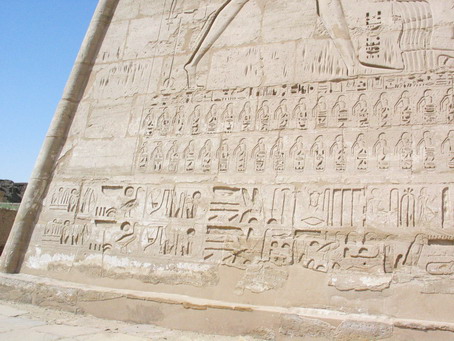
The Temple measures 600 feet by 220 feet. The eastern pylon of the Temple was the main entrance and was once decorated with scenes of the battle of Kadesh, but it is in ruins today! On the right wing of the pylon you will find inscriptions that represent the 118 cities that Ramses III had conquered during his military campaigns. You will also see scenes of prisoners taken to the King. On the left wing of the pylon there are scenes of the famous battle between Ramses II and the Hittites. After that you will proceed onto the first open courtyard, where you will see many damaged statues. Once there was a colossal statue of Ramses II, and at its feet, it read:

"My name is Ozymandias, King of Kings: Look upon my works, ye Mighty, and despair"

In the great hypostyle hall there are 29 columns that are still standing, the ones in the middle are shorter than those on the sides to allow light into the Temple! Here, on the left side, you can see more scenes of the battle of Kadesh.
On the right of this hall, and outside the walls of the hypostyle hall, lies a much older Temple, built by Seti I and dedicated to the God Amon Ra. The Second courtyard is in a much better condition, than the first one, and you can see on both sides, two rows of Osiris columns, representing Ramses II. Further south there is another small hypostyle hall that once had 8 papyrus-bud columns. In here the hall of astronomy is located, where the first 12th month calendar is illustrated. This hall is decorated with scenes of offering, and scenes of the sacred boat of Amon Ra. On the western wall you will see Ramses II sitting under the tree of life, where the God Thoth and the Goddess Seshat are recording his name, in the leaves of the tree, for long life.
If you go further into the western side, there are the ruins of two vestibules that lead you to a library, linen room and the badly ruined sanctuary, which was dedicated to the God Amon Ra.

To the south of the Temple, Ramses II built a great mud break palace where he stayed during his visits to the site. To the south of this section, lies the small Temple of Mern-Ptah, the successor of Ramses II. In 1896, the great Egyptologist, William Flinders Petrie, did extensive excavations at this site.

Petrie found here a very important Stella, known as the "Israel Stella", which contained the first reference to the "Tribe of Israel". Because of this Stella, many archaeologists believe that Mern-Ptah is very likely to be the Pharaoh of the Exodus


Tuesday, 1 August 2017

The Luxor Museum, Luxor

The Luxor Museum, Luxor

The location of the Museum:

The Luxor Museum is located on the East Bank of the River Nile in the city of Luxor in a very attractive location between Karnak Temple in the North and Luxor Temple in the South.


The building of the museumis 55 meters long and 29 meters wide. The facade of the Luxor museum was designed to face the Nile.


The description of the Luxor Museum:

The museum was opened for public for the first time in 1975. However, the Museum at the time was never to be compared to the Egyptian antiquities museum in Cairo, but with time passing by, the Egyptian supreme council of antiquities started adding more and more items and displays to the Luxor Museum to increase the number of tourists visiting the museum.

The museum has a garden that contains a number of interesting displays combining a big open air museum. There are many sculptures from the pharos era, especially the new kingdom located in the garden of the Luxor Museum.

The visitor, after viewing the displays in the garden, enters the museum through a large glass door. The main hall of the museum consists of two levels with spiral corridors linking the levels together and giving the museum a dynamic atmosphere different from other old traditional museums. These spiral corridors allow the visitors to move around easily in the museum without causing any.


When the visitor enters the first floor of the Luxor museum, he can view a magnificent collection of Egyptian sculpture including an amazing statue of the crocodile god, Sobek that was brought from his temple in Kom Ombo. There is also the remaining of the walls of the temple of Amenhotep IV that once stood high in the city of Luxor

There are also some colorful coffins in the first floor of the Luxor Museum. To the left side of the first floor, there are some remarkable statues that were found in the Luxor museum and were added to the museum in 1989

The Luxor Museum contains displays that cover a period of more than four thousand years, from prehistoric era to the Islamic era. The displays in the Museum are only chosen examples of the huge collection of antiquities that are being kept in stores.

The most important items on display in the Luxor museum include:

- There are the mud brick walls of the Temple of Akhenaton (1347 -1364 BC).

- The statue of Thutmose III was the sixth Pharaoh of the Eighteenth Dynasty. The statue is 90 cm long and made out of special rock formation. Thutmose is one of the greatest pharos of the time.

- The statue of Amenhotep III that was brought from Madenet Habu in the west bank of Luxor. Amenhotep III was a very important figure in ancient Egypt (1365 – 1403 BC) and he was he was raised to the rank of gods during the Ptolemaic era. His statues in the Luxor Museum is remarkable as it is 130 cm and it was made out of pure black granite

- The statue called "Oshbey", or the "answerer" in the hydrographic language. He was the one doing the cultivating work in the afterlife for the owner of the tomb. This statue goes back to the end of the 18th dynasty and it was made out of colored wood. The statue is 23 cm long and it is of a man holding an ax in his right hand a bag of seeds in his left hand.


- The cartoon mummy cover that was found in one of the tombs of the west bank of Luxor. The cover is 175 cm long and 42 cm wide. It belongs to the third intermediate period, the dynasties 21 to 24. It was made out of flax and plaster. These mummy covers were called cartonage and it was used as an outer cover of the mummy covered with funerary scenes.

- Some displays from the collection of the Tut Ankh Amun tomb in the valley of the kings in the west bank


- The royal mummies of Ahmose I and Ramsis I that were added to the museum in 2004

- The museum hosts a collection of Coptic antiquities that include a pottery white and black colored dish that was found in the 5th century AD.


- The museum display a lot of Islamic items as well like the collection of small bowls that belong to the Mamluk era going back to the 14th century AD.


- A tall Pillar of King Sesostris I. which was made out of colored limestone

- A huge head of a statue of Akhenaton wearing a double crown


- A calcite statue of Amenhotep III and the crocodile god Sobek
- 
- Part of a wall from the Temple of Akhenaton at Karnak.

- Collection of 26 well preserved New Kingdom sculptures found buried in a near the Luxor Temple in 1989.


- A statue of Horemheb was the last king of the 18th Dynasty with the god Atom


- A black granite statue of the famous goddess Hathour, the goddess of beauty


- A statue of the goddess Inet, the wife of the god Monto, from the reign of Amotep III


- A granite statue of The goddess Mot together with the famous god Amun, the statue goes back to the reign of Ramsis II

- A canopy head of queen Toya from the reign of Seti the first

- A wax statue of Ramsis the 11th accompanied by the god Ma'at that was discovered in 1978 in the west bank
-------------------------------------------------------------------

HOURS OF OPERATION: 
Winter: open daily 9AM-9PM
Summer: open daily 9AM-4PM, 5PM-10PM
Last ticket sold 30 minutes before closing

TICKET COST: 
General Admission: (Ticket includes both museum and ruins)
Egyptian: LE 8 (LE 4, students)
Foreign: LE 70 (LE 35, students)

Student rates available to bearers of a valid student ID from an Egyptian university or an International Student ID Card (ISIC)

LOCATION: 
Corniche el-Nil, downtown Luxor

DIRECTIONS: 
By taxi: ask for "met-haf al-luxor"

FACILITIES: 
Visitors' center, cafeteria, bookshop, library
No audio or personal guides are provided, but a catalogue of the museum collection is available for purchase in the bookstore.

The museum is wheelchair-accessible.

CONTACT INFO: 
Phone: (095) 370569

NO PHOTOGRAPHY ALLOWED.

Temple of Dendera, Luxor

Temple of Dendera, Luxor

Visitors to Luxor, who have the time, should try and visit the famous Temple of Hathor at Dendera. In a taxi, the trip takes about 1hour from Luxor. The buses, which are always accompanied by a Police convoy, that leaves at 0800 daily . The entrance fee is LE 35.


The Temple is located about 4KM from the River Nile, on its west bank, roughly opposite the city of Qena, the capital of the province and governorate of Qena (population - 2,000,000), which is inhabited by both Coptic and Muslims. This town is very famous for the manufacture of water pots, called "gula" jars in Arabic.

The Muslim Sheik, Abdel Raheeem El-Kenawi, who spent all of his life in this town and died in 1170 A.D, founded the modern city. The birthday of this saint is celebrated every year, and a great number of pilgrims come from all over Egypt for the festivities. The name of the city goes back to the time of the Pharaohs , and was taken from the ancient Egyptian word Qeny, which means, "to bend"; the River Nile has a huge (and famous) bend here.

The Temple of Hathor was built in the 1st century B.C and it is one of the best-preserved Temples in the whole of Egypt! Ptolemy VIII and Queen Cleopatra II built it, and then later, Roman Emperors continued to decorate it and honour the Goddess Hathor; the Goddess of maternity, love and music. The Greeks identified the Goddess Hathor as Aphrodite.

The first gateway, built by Roman Emperor Domitian in 80 A.D, leads to the great hall of the Temple, which is decorated with Hathoric columns (columns with the face of Hathor on them) and is in a very good condition. The upper, front edge of the cornice is decorated with the winged sun disc, while stone screens between the columns and the scene, which represent the Roman Emperor Tiberius and other Roman rulers who present votive offerings to the Goddess of the Temple, enclose the front portion. Hathor is chiefly represented with the horns of the sacred cow protruding from her head, supporting the solar disc of the sun, and in her hands she is holding an "Ankh", the symbol of life, and a sceptre. Sometimes she is also represented with the head of a cow.

The interior walls of the great hall have remarkable scenes that mainly depict sacrifices being made to the Goddess of the Temple. The amazing ceiling, with its astronomical representations, is very interesting! The ceiling is divided into 7 divisions, and the best remaining 3 are:

The first division on the eastern side, which depicts the Goddess Nut, the Goddess of the sky, who is bending herself towards the earth, with the sun disc shining on the Temple and the mask of Hathor.

Secondly, and next to the first, is a representation of the sun boat and star Goddess.

The third one is the western ceiling, which shows a perfect representation of the zodiac signs, which is one of the reasons that the Temple is so famous (the original zodiac relief is now in the Louvre museum in Paris, France). The 12 figures of the ram, the bull, the heavenly twins, the crab, the lion, the virgin, the scales, the scorpion, the archer, the goat, the watering pots and fishes with glittering tails. On the inner walls of the screen, the hawk headed God Horus, and the Ibis headed God Thoth, are pouring drops of holy water over the King. This scene is called the baptism scene, symbolising life and happiness.

The second hall has 6 columns adorned with rich capitals and granite pedestals. On both sides of this hall are small rooms that were used as storerooms, used to store the wine jars that came from the Island of Crete, and the fertile Fayoum and Kharga oases.

Next is the central chapel, which has two altars; one for the sacred boat, and the other for the sacrifices offered to the Goddess Hathor. The beautifully sculptured relief's on the walls of the shrines represent Ptolemy VIII and other rules, whose names were left blank in the oval cartouches, dancing with offerings to the sacred boat of Hathor and her husband Horus. The representatives of the King, the high Priests and noblemen, used to gather in the great hall in preparation for the daily rituals. The ceilings are covered in stars, and black soot from the fires of the later inhabitants of the Temple.The rooms around the sanctuary were used for scientific purposes, the storing of the sacred boat, the sacred wreath, the golden image of the Goddess Hathor and musical instruments

There is a small corridor on the right, which leads to a small room that contains the crypt, highly recommended should you visit here.

The staircases, which lead to the roof of the Temple, are decorated with some beautiful symbols representing the 12 months of the year. On the eastern corner, of the roof, is the chapel of the God Osiris. The scenes on its walls represent Osiris rising from the dead and becoming the God of the underworld. It is from this chapel that the best representation of the zodiac was taken.


The southern exterior wall relief show Cleopatra VII and her son Caesarian, son of JuliusCaesar, making offerings to Hathor and allthe other deities of Dendera. On the same wall, near the cornice, are some stone lion heads, serving as water spouts. Adjoining the Temple building to the west is the sacred lake, which was used for the priests' ablutions. Next to the lake is a small shaft, discovered in 1917, which contained valuable treasures of Cleopatra's era, which are now displayed in the Egyptian Museum.


Around the Temple are the remains of the mud brick wall, which surrounded the whole Temple, as well as the ruins of Coptic houses and churches, including a large number of Coptic crosses, which were chiseled into the stones. To the north lies the Mamisi, the birth house of Horus, the son of Isis and Osiris, which was erected by the Roman Emperor Trajan in 90 A.D. This little Temple is surrounded by a row of columns, with different capitals embellished with relief images of the God Bes, the chief God of childhood who drove evil spirits away from the babies. Bes is a hideous dwarf, with a big stomach and long whiskers.Around the Temple are the remains of the mud brick wall, which surrounded the whole Temple, as well as the ruins of Coptic houses and churches, including a large number of Coptic crosses, which were chiseled into the stones. To the north lies the Mamisi, the birth house of Horus, the son of Isis and Osiris, which was erected by the Roman Emperor Trajan in 90 A.D. This little Temple is surrounded by a row of columns, with different capitals embellished with relief images of the God Bes, the chief God of childhood who drove evil spirits away from the babies. Bes is a hideous dwarf, with a big stomach and long whiskers.Coptic crosses, which were chiseled into the stones. To the north lies the Mamisi, the birth house of Horus, the son of Isis and Osiris, which was erected by the Roman Emperor Trajan in 90 A.D. This little Temple is surrounded by a row of columns, with different capitals embellished with relief images of the God Bes, the chief God of childhood who drove evil spirits away from the babies. Bes is a hideous dwarf, with a big stomach and long whiskers.

Temple of Madinet Habu, Luxor

Temple of Madinet Habu, Luxor

The Temple of Medinat Habu is one of the largest memorial Temples in Egypt. It measures 320 m in length (East to west) and about 200 m in width (North to south). It was built to commemorate Ramses III, after his death, by orders of the King himself. A huge mud brick enclosure wall surrounds the Temple. 

This building basically consists of a huge gate, which takes the shape of a Syrian fort, and is decorated with battle scenes of the King's wars in Syria. After accessing the gate there is a shrine, which dates back to the 18th Dynasty, on the right hand side. There is also a wide-open court that leads to a huge pylon, which has both towers decorated with battle scenes. On one tower the King, wearing the red crown with his "Ka" or "double", smiting his enemies in front of Re-Horakhty. On the other tower, the King is represented with the red crown of Lower Egypt, smiting his enemies in front of the God Amon Ra. 

One of the most wonderful scenes engraved on the back of the southern tower, is the oxen hunt, which depicts Ramses III, leading his chariot, hunting wild oxen. Here you will notice that the sculptor was very skilful in showing the pain of the wounded animals. 

 The 1st open court measures 42m long by 33m wide. Its walls are decorated with battle scenes fought against the Syrians and the Libyans.


The 2nd courtyard (42m long by 38m wide) was converted into a basilica in the early Christian times, but there are scenes representing religious ceremonies, especially the festival of the Gods Sokker (also spelt Sokar) and Min. Other scenes represent the King, with the priests, making offerings to various deities.


The 1st Hypostyle is badly damaged, probably by an earthquake in 27 B.C. It contained 24 columns in 6 rows, surrounded by 16 chapels: 8 to the right and 8 to the left. Among the most important shrines on the right side are the first one, which was dedicated to King Ramses III, chapel number 2, which was dedicated to the God Ptah, chapel number 4, which was consecrated for the boat of the God Sokker, and chapel number 7 which was dedicated to the sacred boat of the God Amon Ra.


The chapels on the left side were dedicated to storing the utensils of the Temples, except for chapel number 14, which was dedicated to the sacred boat of King Ramses II, and chapel number15, which was dedicated to the divine boat of the God Montho.

The 2nd Hypostyle hall contains 8 papyrus columns in 2 rows.  The 3rd Hypostyle hall is similar to the 2nd Hypostyle hall and its ceiling was supported by 8 columns in 2 rows. 


At the end of this hypostyle hall there are three entrances, the one in the centre leads to the sanctuary where the sacred boat of Amon Ra was placed, the one to the right side leads to the chapel of the God Khonso while the one of the left side leads to the chapel of the Goddess Mut.

The Sanctuary at the end of the Temple consists of 3 chapels as mentioned before; it was dedicated to the “Triad of Thebes”, and was surrounded by many side chambers.   

Temple of Abydos, Luxor

The Temple of Abydos

The Temple of Abydos is located to the west of El-Baliana, which is a town in Sohag Governorate. In ancient times it was called Abdu, and the Greeks called it Abydos.  Abydos, the 8th province in ancient Egypt, this area is considered to be amongst the most famous archaeological sites.  It was the city were Menna, the unifier of upper and lower Egypt came from and from the 11th Dynasty onwards, a burial in Abydos was the ultimate wish and honor for any local to have. In Abydos, many tombs were found belonging to the 1st and 2nd Dynasties. Also, many Kings  have built Temples here, including King Pepi I, King Ahmose I, King Seti I and King Ramses II.

Ancient Egyptians believed that the tomb of Osiris, the “God of the Dead, and the underworld” was located in Abydos, and it is where his head was buried.

The Temple of Seti I:


The Temple was built During the reign of King Seti I and was finished by, first, his son  Ramses II and then followed by his son, King Mern-Ptah


This temple is  quite unique in design,  as has a  shape of an “L” letter upside down. It also contains the most complete lists of Kings and Gods. The Temple contains 7 shrines dedicated to 7 Gods: Osiris, Isis, Horus, Amon Ra, Ra HorAkhty and Ptah, and Seti I as a deified King. in this temple one will  find the best-preserved painted reliefs and texts from the 18th Dynasty.

The Temple of Abydos was constructed with white marble and once had a large pylon built by Ramses II. 


The front of the Temple is a square columned façade and there are 12 rectangular pillars with decoration of Ramses II welcoming the Gods Osiris, Isis and Horus. The Temple originally had 7 gates leading to 7 shrines originally constructed by Seti I, but Ramses II made additional parts to the construction, and only there is one gate open now.


This gate leads to a hypostyle hall, which was built and decorated by King Ramses II, where the columns are decorated with papyrus bud capitals. There are many representations of Ramses II offering to many Gods, here.


Further west, you will find the second hypostyle hall, which is the more impressive! Seti II built this hall, the walls depicting Seti I giving offerings, to Osiris and Horus, in front of Osiris shrine. The decorations in this hall are the best

in the Temple; the fine painted relief being of the highest standard.


Behind that hall there are 7 sanctuaries, dedicated by Seti I, and made for Osiris, Isis, Horus, Amon Ra, Ra HorAkhty, Ptah and Seti I as a deified King. It is believed that these shrines once contained the sacred boats of the God's. Each of them has false doors (except for Osiris) with a Stella mentioning the God.  The shrine of Osiris doesn't have a false door; it has representations of the God Osiris’ Jed sign (the pillar of Osiris), with scenes of the Osiris myth.

 To the left of the 2nd hypostyle hall, there are two entrances. One leads to the hall of Sokker and Nefertum, while the other leads to a narrow decorated hall, with a list of 76 Kings. Missing from this list are the names of the “heretic King”, Akhenaton, and Queen Hatshepsut.


This corridor leads to the hall of sacred boats, where the sacred boats where stored, there was also a hall for sacrifices, where the animals got slaughtered.