Wednesday, 2 August 2017

Temple Of Karnak, Temple of Amon-Ra

Temple Of Karnak, Temple of Amon-Ra

The Temple of Karnak is the largest Temple in the World! The complex contains a group of Temples such as the Great Temple of Amon Ra, The Temple of Khonso, The Ipt Temple, The Temple of Ptah, the Temple of Montho and the Temple of the God Osiris. A 20m high, mud brick enclosure wall, surrounded all of these buildings.


This great Temple of Amon Ra was known during the Middle Kingdom period as Ipt-Swt, which means the Selected Spot. It was also called Pr-Imn, which means the House of Amon. The name Al-Karnak in Arabic was derived from Karnak, which means fortified village, probably because the Arabs found many Temples and buildings in the area when they entered it for first time.
On your way towards the entrance you will find a ram-headed avenue of Sphinxes, which was built to protect the Temple. There are 20 rams on each side, extending from the small harbour to the 1st Pylon, which was built during the time of King Nektanebo I (30th Dynasty). As you cross this pylon, it takes you into an Open court, whose dimensions are100m long by 80m wide, built during the 22nd Dynasty, and containing rows of bud papyrus columns.

In the middle of the 1st Open court, there is a huge column, which is 21m high and has a bud papyrus capital. This part is known as the kiosk of Taharqa who ruled during the 25th Dynasty. This is the only column left from a colonnade that once had 10 columns.
On the left side of this Court there are 3 chapels, which were built by King Seti II for the "Triad of Thebes". On the right side is the Temple of Ramses III. This Temple consists of a small pylon, an open court and Hypostyle hall, leading to the sanctuary.

Horemheb built the 2nd Pylon during the 18th Dynasty, though it is now badly damaged. Ramses I, the founder of the 19th Dynasty, later completed it. Passing the 2nd Pylon, we enter the Great Hypostyle Hall, which measures 103m in length and 52m in width. It contains 134 papyrus columns; each column is about 22m in height and 3.5m in diameter. Amenhotep III built it and Ramses I, Seti I, and Ramses II decorated it, while King Seti I erected the other 122 columns in 14 rows. 
The ceiling in the centre is higher than the laterals, and it allows light into this spot, which was the processional avenue of the Triad during the festival of the Opet. The scenes of the Hypostyle Hall represent King Seti I, in front of different deities, making offerings, while the southern wall is decorated with scenes of Ramses II, making offerings to the different deities or worshipping the Triad of Thebes.

The Hypostyle Hall leads to The 3rd Pylon, which was built by Amenhotep III. It is remarkable that stones from previous periods were found incrusted in that Pylon, for example, the marble alabaster of Amenhotep I!

Crossing the 3rd Pylon, you come to an open, rectangular court, which is known as the Court of Tuthmosis I. In this court, Tuthmosis I erected 2 obelisks, as most probably this area was the main entrance of the Temple during his reign. Unfortunately, only one obelisk has survived: 19m high and around 310 tons in weight.

From the Court of Tuthmosis, we reach the 4th Pylon, which Tuthmosis I also built; beyond this is a rectangular colonnade, which he built as well. When Hatshepsut ascended to the throne she built 2 obelisks in that colonnade, the left one is still in its original position: 29.5m in height, 322 tons in weight and made of red granite! 
After the death of Queen Hatshepsut, King Tuthmoses III built a high, long wall around these 2 obelisks to hide them.

The 5th Pylon, yet again built by Tuthmosis I, is damaged and on both sides of the entrance,Tuthmosis III built two small rooms.

We are now at the 6th Pylon, which was built by Tuthmosis III. Beyond this pylon Tuthmosis III built his famous hall, which is known as the Ancestral Room. The original Sanctuary was built by Tuthmosis III, but Philip Arrhidaeus, the half brother of Alexander the Great, later rebuilt it.
The sanctuary was built of granite, and it was dedicated to the sacred boat of Amon Ra. Behind the sanctuary you will see a court, dating back to the time of the Middle Kingdom. It is a wide-open courtyard that is badly damaged now. Most probably this spot was the site of an old Temple, dating back to the time of the Middle Kingdom: the origin of the Karnak Temple. 


At the end of the Middle Kingdom Courtyard, there is another Hall known as the Akh-Mnw, or the Festival Hall of Tuthmosis III. The hall in the north of the area is called The Botanical Room. This is because the walls were decorated with scenes of plants, animals and birds, which were brought from Syria, to Egypt, by the King.

Now we shall go back through the temple until we reach the Court of Tuthmosis 1 again (between the 4th and 3rd Pylons).

Turning left, we enter a courtyard, which is in front of the 7th Pylon. In 1902, the French Egyptologist Georges Legrain (1865–1917) discovered a very precious collection of statues hidden in the ground of this court, which is now known as the Court of the Cashet. The 7th Pylon, which is badly damaged, was built by Tuthmosis III.

Crossing the 7th Pylon to the court beyond, you will see 2 statues of Ramses II and Tuthmosis III.

The 8th Pylon was built by Hatshepsut, decorated by Tuthmosis III, and restored by Seti I. The scenes on the façade of the Pylon represent Hatshepsut with different deities, and a religious scene featuring Tuthmosis III.

On the left side of the Court, between the 9th and 10th Pylons, are the remains of the Heb-Sed Shrine, which was built by Amenhotep II and decorated by Seti I.

The 9th Pylon, which was built by Horemheb, is badly damaged. A large number of bricks were found inside, which were being used as filling. They belonged to the Aton Temple, which was built by Amenhotep VI (Akhenaten) in the 18th Dynasty and destroyed by later Kings who wanted to eliminate all traces of the "heretic" King.

Finally we reach the 10th Pylon, damaged as well, and again built by King Horemheb. In front of this Pylon there are the remains of an avenue of Sphinxes, built by Horemheb, and extending to the gate of Ptolemy II in front of Mut Temple.

Before leaving the Temple of Amon Ra at Karnak you should visit the Sacred Lake, which goes back to the time of Tuthmosis III. It measures 80m in length and 40m in width. Near the Sacred Lake there is a scarab, which is considered the biggest scarab left from Ancient Egypt, dating from the reign of Amenhotep III. The Ancient Egyptians called the scarab, Khebry, and it was the symbol of the Sun God. The word itself means to create; it was thought to bring to the sun in the early morning.


While you are in Luxor, why don't you attend the marvelous Sound and Light show at the Temple of Karnak?

Listed below you will find the Sound and Light show schedule.

Please Note: An additional camera ticket of 35 EGP is required if you use your video camera at the show

Mummification in Ancient Egypt

Mummification in Ancient Egypt

Mummification was practiced in Ancient Egypt tin order to preserve the body for the after life . mummy

Ancient Egyptian believed in life after death This practice started and early as the old kingdom time in Ancient Egypt but it reach it is peak during the new kingdom. This ritual was essential to guarantee the survival of both the soul and the body. The ritual of mummification has been through many stages of evolution and, but most of its secrets have not been completely revealed yet.

Traditionally all what we know of the mummification came to us the classical sources of history such as Greek writers and papyrus drawing and wall relives and the rest through studying the mummies that e found intact inside the ancient Egyptian tombs.


The most common way of mummification was as follows:mummy

The brain was removed through the nose and was discarded. The viscera was removed and stored in jars known today as the canopic jars, while the body was soaked into Naturn salt for 70 days until it was dehydrated, artificial ayes were placed instead of the real eyes which had dehydrated , then body is wrapped with 100 's of meters of gum coated linen and the jewels were inserted within the layers of the wrapping.


Canopic Jars:

It was necessary to complete the mummification conserving the interior limbs such as the brain , the viscera and so on , putting them into a square chest which was at first , during the old Kingdom it was divided into 4 compartments and was placed into a pit near to the sarcophagus, this box was made of stone or wood. Then apart from the ends of the 4th dynasty and en general during the Middle Kingdom and the Modern Kingdom that chest was turned to 4 jars .The stopper s of these jars are taken the shapes of 4 different heads ( according to the shapes of the 4 sons of Horus )

he Canopic jars are as follows:mummy

- The first was Am-sty, with human head shape. 

- The 2nd one was Hapy with a monkey head,.

- The 3rd one was Dwa-mut-f with a Jackal head,

- The 4th was Kbh-snw- f with a falcon head.

The Greeks called these jars the Canopic Jars relating them to the deity of the old City "Canop" now it is village in the province of (Abu Kyr). That deity was carry the name of Osiris and was represented in the shape of a jar with Osiris head. And during the Ptolemaic period these jars were called the canopic jars. 

Tuesday, 1 August 2017

The Luxor Museum, Luxor

The Luxor Museum, Luxor

The location of the Museum:

The Luxor Museum is located on the East Bank of the River Nile in the city of Luxor in a very attractive location between Karnak Temple in the North and Luxor Temple in the South.


The building of the museumis 55 meters long and 29 meters wide. The facade of the Luxor museum was designed to face the Nile.


The description of the Luxor Museum:

The museum was opened for public for the first time in 1975. However, the Museum at the time was never to be compared to the Egyptian antiquities museum in Cairo, but with time passing by, the Egyptian supreme council of antiquities started adding more and more items and displays to the Luxor Museum to increase the number of tourists visiting the museum.

The museum has a garden that contains a number of interesting displays combining a big open air museum. There are many sculptures from the pharos era, especially the new kingdom located in the garden of the Luxor Museum.

The visitor, after viewing the displays in the garden, enters the museum through a large glass door. The main hall of the museum consists of two levels with spiral corridors linking the levels together and giving the museum a dynamic atmosphere different from other old traditional museums. These spiral corridors allow the visitors to move around easily in the museum without causing any.


When the visitor enters the first floor of the Luxor museum, he can view a magnificent collection of Egyptian sculpture including an amazing statue of the crocodile god, Sobek that was brought from his temple in Kom Ombo. There is also the remaining of the walls of the temple of Amenhotep IV that once stood high in the city of Luxor

There are also some colorful coffins in the first floor of the Luxor Museum. To the left side of the first floor, there are some remarkable statues that were found in the Luxor museum and were added to the museum in 1989

The Luxor Museum contains displays that cover a period of more than four thousand years, from prehistoric era to the Islamic era. The displays in the Museum are only chosen examples of the huge collection of antiquities that are being kept in stores.

The most important items on display in the Luxor museum include:

- There are the mud brick walls of the Temple of Akhenaton (1347 -1364 BC).

- The statue of Thutmose III was the sixth Pharaoh of the Eighteenth Dynasty. The statue is 90 cm long and made out of special rock formation. Thutmose is one of the greatest pharos of the time.

- The statue of Amenhotep III that was brought from Madenet Habu in the west bank of Luxor. Amenhotep III was a very important figure in ancient Egypt (1365 – 1403 BC) and he was he was raised to the rank of gods during the Ptolemaic era. His statues in the Luxor Museum is remarkable as it is 130 cm and it was made out of pure black granite

- The statue called "Oshbey", or the "answerer" in the hydrographic language. He was the one doing the cultivating work in the afterlife for the owner of the tomb. This statue goes back to the end of the 18th dynasty and it was made out of colored wood. The statue is 23 cm long and it is of a man holding an ax in his right hand a bag of seeds in his left hand.


- The cartoon mummy cover that was found in one of the tombs of the west bank of Luxor. The cover is 175 cm long and 42 cm wide. It belongs to the third intermediate period, the dynasties 21 to 24. It was made out of flax and plaster. These mummy covers were called cartonage and it was used as an outer cover of the mummy covered with funerary scenes.

- Some displays from the collection of the Tut Ankh Amun tomb in the valley of the kings in the west bank


- The royal mummies of Ahmose I and Ramsis I that were added to the museum in 2004

- The museum hosts a collection of Coptic antiquities that include a pottery white and black colored dish that was found in the 5th century AD.


- The museum display a lot of Islamic items as well like the collection of small bowls that belong to the Mamluk era going back to the 14th century AD.


- A tall Pillar of King Sesostris I. which was made out of colored limestone

- A huge head of a statue of Akhenaton wearing a double crown


- A calcite statue of Amenhotep III and the crocodile god Sobek
- Part of a wall from the Temple of Akhenaton at Karnak.

- Collection of 26 well preserved New Kingdom sculptures found buried in a near the Luxor Temple in 1989.


- A statue of Horemheb was the last king of the 18th Dynasty with the god Atom


- A black granite statue of the famous goddess Hathour, the goddess of beauty


- A statue of the goddess Inet, the wife of the god Monto, from the reign of Amotep III


- A granite statue of The goddess Mot together with the famous god Amun, the statue goes back to the reign of Ramsis II

- A canopy head of queen Toya from the reign of Seti the first

- A wax statue of Ramsis the 11th accompanied by the god Ma'at that was discovered in 1978 in the west bank
-------------------------------------------------------------------

HOURS OF OPERATION: 
Winter: open daily 9AM-9PM
Summer: open daily 9AM-4PM, 5PM-10PM
Last ticket sold 30 minutes before closing

TICKET COST: 
General Admission: (Ticket includes both museum and ruins)
Egyptian: LE 8 (LE 4, students)
Foreign: LE 70 (LE 35, students)

Student rates available to bearers of a valid student ID from an Egyptian university or an International Student ID Card (ISIC)

LOCATION: 
Corniche el-Nil, downtown Luxor

DIRECTIONS: 
By taxi: ask for "met-haf al-luxor"

FACILITIES: 
Visitors' center, cafeteria, bookshop, library
No audio or personal guides are provided, but a catalogue of the museum collection is available for purchase in the bookstore.

The museum is wheelchair-accessible.

CONTACT INFO: 
Phone: (095) 370569

NO PHOTOGRAPHY ALLOWED.

The Colossi of Memnon, Luxor

The Colossi of Memnon, Luxor

Dating from the New Kingdom, 18th Dynasty, during the reign of Amenhotep III, The Colossi of Memnon is a mortuary temple located in Thebes in Egypt. The mortuary temple of the pharaoh is guarded by two statues of about 20 meters in height which saw severe damage during the earthquake that occurred in 27 BC. The temple has now been destroyed completely and all that remains is the 23 meters high statue of Amenhotep III which weighs around thousand ton. The statues even after such destruction by natural and manly action seem to be an impressive piece.


The two statues by ancient Egyptians were referred as Ruler of Rulers and later on travelers named the same as Shammy and Tammy probably meaning left and right. Today however, the two colossal statues once, are designated as el-Colossal or es-Salamat. The statues are crafted from quartzite which has been quarried either from Gebes es Silisla or Giza. The northern statue on the other hand illustrates the pharaoh with this mother while the southern one seems to be of the Pharaoh with his wife and one of his daughters.

The two statues before this were located in front of the mortuary temple of Amenhotep III which was destroyed due to some reason. The two Colossi of Memnon are now made of Sandstone and each one consists of a pedestal and the crown and is about 21 meters in heights. The statue now represents the pharaoh seated on the throne wearing the royal headdress of the Nemes which has the divine cobra protecting the same. The sides of the colossi have a representation of the god Hapi of the Nile bending together the papyrus plants and the lotus. The place was famous as a resort during the roman era where many famous travelers and Romans wrote versus and poems about the massive structures and also left behind epigrams on the stones.


Visitors are believed to have visited this place from all across the place to hear the song which was granted to show that you were in favor of the gods. However Septimius Severus, a roman emperor while repairing the statues inadvertently silenced the same forever.

Theories behind the signing status at the Clossi of Memnon

The Colossi of Memnon is believed to have been so popular during the Roman period as it’s said that the statues sung. It’s probably due to the expansion of the stone phenomenon which occurred when the sun got very warm during the day time and when the same cooled off in the evening and contracted.


Another theory suggests that the reverberating wind through the cracks made the sounds. However the restoration that occurred during 199 BC led to stopping of this sound forever meaning the statues no longer sung again.


How to get to the Colossi of Memnon

The Colossi of Memnon is located about half a kilometer east of the Antiquities Inspectorate (the ticket office) on the main road to the West Bank monument area. The statues are always open and no ticket is required to visit the same.

Temple of Dendera, Luxor

Temple of Dendera, Luxor

Visitors to Luxor, who have the time, should try and visit the famous Temple of Hathor at Dendera. In a taxi, the trip takes about 1hour from Luxor. The buses, which are always accompanied by a Police convoy, that leaves at 0800 daily . The entrance fee is LE 35.


The Temple is located about 4KM from the River Nile, on its west bank, roughly opposite the city of Qena, the capital of the province and governorate of Qena (population - 2,000,000), which is inhabited by both Coptic and Muslims. This town is very famous for the manufacture of water pots, called "gula" jars in Arabic.

The Muslim Sheik, Abdel Raheeem El-Kenawi, who spent all of his life in this town and died in 1170 A.D, founded the modern city. The birthday of this saint is celebrated every year, and a great number of pilgrims come from all over Egypt for the festivities. The name of the city goes back to the time of the Pharaohs , and was taken from the ancient Egyptian word Qeny, which means, "to bend"; the River Nile has a huge (and famous) bend here.

The Temple of Hathor was built in the 1st century B.C and it is one of the best-preserved Temples in the whole of Egypt! Ptolemy VIII and Queen Cleopatra II built it, and then later, Roman Emperors continued to decorate it and honour the Goddess Hathor; the Goddess of maternity, love and music. The Greeks identified the Goddess Hathor as Aphrodite.

The first gateway, built by Roman Emperor Domitian in 80 A.D, leads to the great hall of the Temple, which is decorated with Hathoric columns (columns with the face of Hathor on them) and is in a very good condition. The upper, front edge of the cornice is decorated with the winged sun disc, while stone screens between the columns and the scene, which represent the Roman Emperor Tiberius and other Roman rulers who present votive offerings to the Goddess of the Temple, enclose the front portion. Hathor is chiefly represented with the horns of the sacred cow protruding from her head, supporting the solar disc of the sun, and in her hands she is holding an "Ankh", the symbol of life, and a sceptre. Sometimes she is also represented with the head of a cow.

The interior walls of the great hall have remarkable scenes that mainly depict sacrifices being made to the Goddess of the Temple. The amazing ceiling, with its astronomical representations, is very interesting! The ceiling is divided into 7 divisions, and the best remaining 3 are:

The first division on the eastern side, which depicts the Goddess Nut, the Goddess of the sky, who is bending herself towards the earth, with the sun disc shining on the Temple and the mask of Hathor.

Secondly, and next to the first, is a representation of the sun boat and star Goddess.

The third one is the western ceiling, which shows a perfect representation of the zodiac signs, which is one of the reasons that the Temple is so famous (the original zodiac relief is now in the Louvre museum in Paris, France). The 12 figures of the ram, the bull, the heavenly twins, the crab, the lion, the virgin, the scales, the scorpion, the archer, the goat, the watering pots and fishes with glittering tails. On the inner walls of the screen, the hawk headed God Horus, and the Ibis headed God Thoth, are pouring drops of holy water over the King. This scene is called the baptism scene, symbolising life and happiness.

The second hall has 6 columns adorned with rich capitals and granite pedestals. On both sides of this hall are small rooms that were used as storerooms, used to store the wine jars that came from the Island of Crete, and the fertile Fayoum and Kharga oases.

Next is the central chapel, which has two altars; one for the sacred boat, and the other for the sacrifices offered to the Goddess Hathor. The beautifully sculptured relief's on the walls of the shrines represent Ptolemy VIII and other rules, whose names were left blank in the oval cartouches, dancing with offerings to the sacred boat of Hathor and her husband Horus. The representatives of the King, the high Priests and noblemen, used to gather in the great hall in preparation for the daily rituals. The ceilings are covered in stars, and black soot from the fires of the later inhabitants of the Temple.The rooms around the sanctuary were used for scientific purposes, the storing of the sacred boat, the sacred wreath, the golden image of the Goddess Hathor and musical instruments

There is a small corridor on the right, which leads to a small room that contains the crypt, highly recommended should you visit here.

The staircases, which lead to the roof of the Temple, are decorated with some beautiful symbols representing the 12 months of the year. On the eastern corner, of the roof, is the chapel of the God Osiris. The scenes on its walls represent Osiris rising from the dead and becoming the God of the underworld. It is from this chapel that the best representation of the zodiac was taken.


The southern exterior wall relief show Cleopatra VII and her son Caesarian, son of JuliusCaesar, making offerings to Hathor and allthe other deities of Dendera. On the same wall, near the cornice, are some stone lion heads, serving as water spouts. Adjoining the Temple building to the west is the sacred lake, which was used for the priests' ablutions. Next to the lake is a small shaft, discovered in 1917, which contained valuable treasures of Cleopatra's era, which are now displayed in the Egyptian Museum.


Around the Temple are the remains of the mud brick wall, which surrounded the whole Temple, as well as the ruins of Coptic houses and churches, including a large number of Coptic crosses, which were chiseled into the stones. To the north lies the Mamisi, the birth house of Horus, the son of Isis and Osiris, which was erected by the Roman Emperor Trajan in 90 A.D. This little Temple is surrounded by a row of columns, with different capitals embellished with relief images of the God Bes, the chief God of childhood who drove evil spirits away from the babies. Bes is a hideous dwarf, with a big stomach and long whiskers.Around the Temple are the remains of the mud brick wall, which surrounded the whole Temple, as well as the ruins of Coptic houses and churches, including a large number of Coptic crosses, which were chiseled into the stones. To the north lies the Mamisi, the birth house of Horus, the son of Isis and Osiris, which was erected by the Roman Emperor Trajan in 90 A.D. This little Temple is surrounded by a row of columns, with different capitals embellished with relief images of the God Bes, the chief God of childhood who drove evil spirits away from the babies. Bes is a hideous dwarf, with a big stomach and long whiskers.Coptic crosses, which were chiseled into the stones. To the north lies the Mamisi, the birth house of Horus, the son of Isis and Osiris, which was erected by the Roman Emperor Trajan in 90 A.D. This little Temple is surrounded by a row of columns, with different capitals embellished with relief images of the God Bes, the chief God of childhood who drove evil spirits away from the babies. Bes is a hideous dwarf, with a big stomach and long whiskers.

Temple of Madinet Habu, Luxor

Temple of Madinet Habu, Luxor

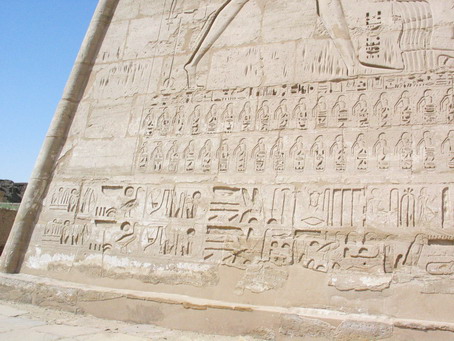
The Temple of Medinat Habu is one of the largest memorial Temples in Egypt. It measures 320 m in length (East to west) and about 200 m in width (North to south). It was built to commemorate Ramses III, after his death, by orders of the King himself. A huge mud brick enclosure wall surrounds the Temple. 

This building basically consists of a huge gate, which takes the shape of a Syrian fort, and is decorated with battle scenes of the King's wars in Syria. After accessing the gate there is a shrine, which dates back to the 18th Dynasty, on the right hand side. There is also a wide-open court that leads to a huge pylon, which has both towers decorated with battle scenes. On one tower the King, wearing the red crown with his "Ka" or "double", smiting his enemies in front of Re-Horakhty. On the other tower, the King is represented with the red crown of Lower Egypt, smiting his enemies in front of the God Amon Ra. 

One of the most wonderful scenes engraved on the back of the southern tower, is the oxen hunt, which depicts Ramses III, leading his chariot, hunting wild oxen. Here you will notice that the sculptor was very skilful in showing the pain of the wounded animals. 

 The 1st open court measures 42m long by 33m wide. Its walls are decorated with battle scenes fought against the Syrians and the Libyans.


The 2nd courtyard (42m long by 38m wide) was converted into a basilica in the early Christian times, but there are scenes representing religious ceremonies, especially the festival of the Gods Sokker (also spelt Sokar) and Min. Other scenes represent the King, with the priests, making offerings to various deities.


The 1st Hypostyle is badly damaged, probably by an earthquake in 27 B.C. It contained 24 columns in 6 rows, surrounded by 16 chapels: 8 to the right and 8 to the left. Among the most important shrines on the right side are the first one, which was dedicated to King Ramses III, chapel number 2, which was dedicated to the God Ptah, chapel number 4, which was consecrated for the boat of the God Sokker, and chapel number 7 which was dedicated to the sacred boat of the God Amon Ra.


The chapels on the left side were dedicated to storing the utensils of the Temples, except for chapel number 14, which was dedicated to the sacred boat of King Ramses II, and chapel number15, which was dedicated to the divine boat of the God Montho.

The 2nd Hypostyle hall contains 8 papyrus columns in 2 rows.  The 3rd Hypostyle hall is similar to the 2nd Hypostyle hall and its ceiling was supported by 8 columns in 2 rows. 


At the end of this hypostyle hall there are three entrances, the one in the centre leads to the sanctuary where the sacred boat of Amon Ra was placed, the one to the right side leads to the chapel of the God Khonso while the one of the left side leads to the chapel of the Goddess Mut.

The Sanctuary at the end of the Temple consists of 3 chapels as mentioned before; it was dedicated to the “Triad of Thebes”, and was surrounded by many side chambers.   

Temple of Abydos, Luxor

The Temple of Abydos

The Temple of Abydos is located to the west of El-Baliana, which is a town in Sohag Governorate. In ancient times it was called Abdu, and the Greeks called it Abydos.  Abydos, the 8th province in ancient Egypt, this area is considered to be amongst the most famous archaeological sites.  It was the city were Menna, the unifier of upper and lower Egypt came from and from the 11th Dynasty onwards, a burial in Abydos was the ultimate wish and honor for any local to have. In Abydos, many tombs were found belonging to the 1st and 2nd Dynasties. Also, many Kings  have built Temples here, including King Pepi I, King Ahmose I, King Seti I and King Ramses II.

Ancient Egyptians believed that the tomb of Osiris, the “God of the Dead, and the underworld” was located in Abydos, and it is where his head was buried.

The Temple of Seti I:


The Temple was built During the reign of King Seti I and was finished by, first, his son  Ramses II and then followed by his son, King Mern-Ptah


This temple is  quite unique in design,  as has a  shape of an “L” letter upside down. It also contains the most complete lists of Kings and Gods. The Temple contains 7 shrines dedicated to 7 Gods: Osiris, Isis, Horus, Amon Ra, Ra HorAkhty and Ptah, and Seti I as a deified King. in this temple one will  find the best-preserved painted reliefs and texts from the 18th Dynasty.

The Temple of Abydos was constructed with white marble and once had a large pylon built by Ramses II. 


The front of the Temple is a square columned façade and there are 12 rectangular pillars with decoration of Ramses II welcoming the Gods Osiris, Isis and Horus. The Temple originally had 7 gates leading to 7 shrines originally constructed by Seti I, but Ramses II made additional parts to the construction, and only there is one gate open now.


This gate leads to a hypostyle hall, which was built and decorated by King Ramses II, where the columns are decorated with papyrus bud capitals. There are many representations of Ramses II offering to many Gods, here.


Further west, you will find the second hypostyle hall, which is the more impressive! Seti II built this hall, the walls depicting Seti I giving offerings, to Osiris and Horus, in front of Osiris shrine. The decorations in this hall are the best

in the Temple; the fine painted relief being of the highest standard.


Behind that hall there are 7 sanctuaries, dedicated by Seti I, and made for Osiris, Isis, Horus, Amon Ra, Ra HorAkhty, Ptah and Seti I as a deified King. It is believed that these shrines once contained the sacred boats of the God's. Each of them has false doors (except for Osiris) with a Stella mentioning the God.  The shrine of Osiris doesn't have a false door; it has representations of the God Osiris’ Jed sign (the pillar of Osiris), with scenes of the Osiris myth.

 To the left of the 2nd hypostyle hall, there are two entrances. One leads to the hall of Sokker and Nefertum, while the other leads to a narrow decorated hall, with a list of 76 Kings. Missing from this list are the names of the “heretic King”, Akhenaton, and Queen Hatshepsut.


This corridor leads to the hall of sacred boats, where the sacred boats where stored, there was also a hall for sacrifices, where the animals got slaughtered.

Luxor Travel Information

Luxor Travel Information

Located in Upper Egypt Luxor has been described as the world’s biggest open air museum. Nowadays it has been elevated to the status of Governorate, though it is still classified as being in the province of Qena. It has a population of round about 230,000, most of who are employed in tourism somehow, though there are many who are employed in agriculture and commerce. It is one of the most popular destinations in Egypt, being one of those places that you must see. Because of this almost every tourist company has an office somewhere in the town.

It has been estimated that Luxor contains about a third of the most valuable monuments and antiquities in the whole world, which makes it one of this planet’s most important tourism sites. Monuments such as The Luxor Temple, Karnak Temple, the Valley of the Kings, the Valley of the Queens, Deir El-Bahri (the Mortuary Temple of Hatshepsut), the workers village at Deir El-Medina, the list goes on and on and on. Though most visitors will stay for just a few days, it would take a substantial amount of time to visit everything in this amazing town.

Once known as Thebes, Luxor’s importance in ancient Egyptian history cannot be denied. It was the religious capital for almost all of the Pharaonic period which is why the town is dominated by the two temples; The Temple of Luxor, and the immense Temple of Karnak; the world’s largest temple complex.

Dedicated to Amun Ra, the Temple of Karnak was constantly expanded by successive pharaohs, each adding his, or her, tribute to the god. The site dates back to the Middle Kingdom under the reign of Mentuhotep (11th Dynasty), but most of what can be seen today is from the New Kingdom. Other parts of the complex include sites dedicated to Mut, the wife of Amun Ra, and their son Khonsu.


Most people know that Luxor was once Thebes, but “Thebes” was not what the ancient Egyptians called it. Ancient texts show that it was called t-apt, which means “the shrine”, with the ancient Greeks calling it tea pie. The Arabs had problems with pronunciation and so it became Thebes to them. The name vanished then as the area submitted to the desert and then by the 10th century Arab travellers thought the ruins were of grand buildings so started to call it Al-Oksour, or “site of the palaces” which slowly became Luxor.


Though it was never the capital of a united Egypt, Thebes was capital of Upper Egypt during the times when Egypt resorted to being split into two. This was especially true during the period of the Hyksos invasion when Avaris became capital in the North. Thebes was where the various pharaohs of Upper Egypt were based, and it was from here that the final campaign, under Ahmose I, to expel the Hyksos originated.


Today Luxor is split into two, by the River Nile, and these two areas are known as the East Bank (where the town lies) and the West Bank. Though this was also true in ancient times, the two parts were called the city of the living (East Bank) and the city of the dead (West Bank). Like most of the River Nile, the western side tends to be more desert, with the eastern side having far more arable land, and so settlement sites tended to favour this latter side.

Luxor is situated 670Km (416 miles) to the south of Cairo, 220Km (137 miles) to the north of Aswan, and 280Km (174 miles) to the west of Hurghada. It is the second most popular place to visit in Egypt, behind Cairo, and is accessible in a number of ways.

By flight:

Luxor International Airport is located 6Km (4 miles) east of the city and can be reached from most countries around the world, though it is most popular for charter flights. From here you can also fly to most of the main cities and towns in Egypt, as well as arriving from them. EgyptAir runs daily flights from Cairo to Luxor, as well as Luxor to Cairo, which take, on average, about 50 minutes.


By train:
Luxor is situated on the main Cairo to Aswan railway line and has a modern station in El-Mahata Square. Services to both Cairo and Aswan are very frequent, though restriction on tourists are in place right now which allows them to only use the sleeper service, or the trains either side of them.

By road
Though Luxor is connected by road to Cairo and has a good bus connection with the capital, tourists are asked not to attempt to use this mode of transport for this journey and are therefore left with only rail or flight as an alternative. The road to Aswan can be used though as it gives the opportunity to visit sites such as Edfu and Kom Ombo. Hurghada is reachable by a 3.5 hour bus journey, opening up the Red Sea for those who wish a change. Please note: if you do intend to use this mode of transport you are best booking your seats at least 24 hours in advance to ensure you get the seats you want.

By Cruise
Nowadays you can only go to Aswan by cruise boat, though some operators do offer the opportunity of a one day sail to see Dendera. The River Nile has not been used for cruises between Cairo and Luxor since the late 1990’s.